Freezone vs Mainland Dubai: Which Is Right for You?
July 8, 2026 · 18 min read
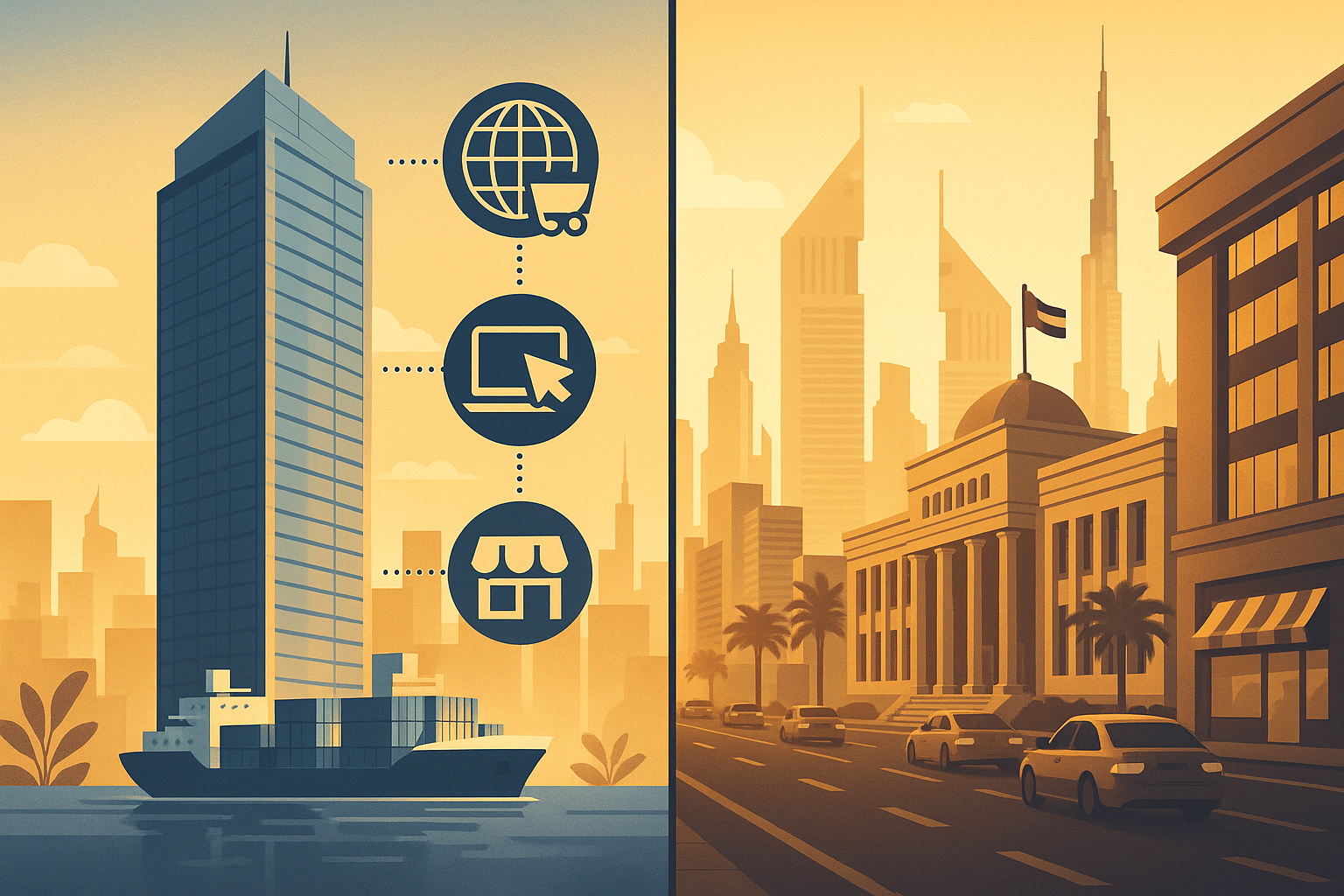
Freezone vs Mainland Dubai: Which Is Right for You?
The single most important decision for your UAE company is freezone vs mainland Dubai — it dictates where you can trade, how many visas you can sponsor, and what your operating costs look like. In short, a freezone gives you 100% foreign ownership and tax breaks but limits you to international or intra‑zone trade unless you use a local distributor. A mainland company, licensed by Dubai’s Department of Economy and Tourism (DET), unlocks the entire UAE market directly, and for most activities you can now own 100% without an Emirati partner.
Key Takeaways
- A freezone company cannot sell directly to the UAE local market; a mainland company can trade anywhere in the country.
- Mainland now permits 100% foreign ownership for over 1,000 commercial and industrial activities — no mandatory local sponsor needed.
- Freezone packages start from AED 5,750 with minimal office overhead; mainland license fees start higher and usually require a physical office lease.
- Visa quotas in freezones are tied to your flexi‑desk package; mainland visas scale with office space, making it better for staffing‑heavy businesses.
- Your business activity is the ultimate filter: professions like consultancy can live in either structure, but retail, restaurants, and government contracts almost always demand a mainland license.
What’s the Real Difference in the Freezone vs Mainland Dubai Setup?
When you compare freezone vs mainland Dubai, the core distinction boils down to trading rights and ownership. A freezone company is registered inside a designated economic zone — places like Meydan FZ, Dubai Airport Freezone, or JAFZA. It gives you 100% foreign ownership, exemption from import and export duties within the zone, and a streamlined setup. But you can’t walk into the Dubai market and sell directly to consumers or local businesses. To reach the mainland, you’d need a local distributor or a separate mainland branch.
A mainland company is licensed by the Dubai Department of Economy and Tourism (DET). It has no trade restrictions — you can do business with any customer anywhere in the seven emirates. You can bid for government contracts, open a shop on a Dubai street, and sponsor an unlimited number of employees as long as your office space allows. Ownership rules are now far more flexible, as we’ll cover next.
For a deeper side‑by‑side look at how these structures operate, you can read our dedicated guide on the Difference Between Freezone and Mainland Company in UAE.

Who Can 100% Own a Mainland Company in 2025? The New Rules Explained
The old picture — an Emirati partner holding 51% of your mainland company — is mostly history. In June 2021, the UAE overhauled its Commercial Companies Law (see the official UAE government summary). Today, over 1,000 commercial and industrial activities qualify for 100% foreign ownership on the mainland, as listed on the UAE’s foreign direct investment page. This change means you can own your entire business, retain all profits, and make decisions without a local sponsor’s signature.
But not every activity is open. Strategic impact sectors — oil and gas, defence, banking, insurance, telecommunications, and certain security‑sensitive services — still require a local partner or a local service agent. Professional service companies (consultancy, IT, marketing) can be 100% foreign‑owned by appointing a local service agent who handles government paperwork but holds no ownership stake. That agent isn’t a sponsor, and you pay a fixed annual fee rather than give away equity.
We always recommend verifying your specific activity against the updated UAE foreign ownership list. If your activity isn’t on the automatic list, you may still apply through the DET’s Foreign Direct Investment unit, but it adds time and complexity to the freezone vs mainland Dubai decision. Getting this wrong at the start can cost you months of delays, so let our team run the eligibility check before you commit.
Head‑to‑Head Comparison: Licensing Costs, Visas, and Office Requirements
When you weigh freezone vs mainland Dubai purely on cost, the numbers tell a clear story. Here’s a practical table comparing the two structures across the three factors that hit your wallet and headcount hardest.
| Cost / Requirement | Freezone (typical) | Mainland (typical) |
|---|---|---|
| License fee (first year) | AED 5,750 – AED 15,000* | AED 10,000 – AED 50,000+ |
| 100% foreign ownership | Yes, always | Yes, for most commercial/industrial activities |
| Office requirement | Flexi‑desk or coworking (AED 500 – AED 2,000/month) | Physical office lease mandatory (AED 8,000 – AED 25,000/month for a small unit) |
| Visa allocation | 1–6 visas per flexi‑desk; extra visas require more space | Approx. 1 visa per 100–150 sq. ft of office space; can be unlimited |
| Annual audit | Usually not required or simple compilation | External audit typically required; auditing fees AED 3,000 – AED 10,000+ |
| Trade name & chamber fees | Often included in package | Chamber of commerce fee AED 400 – AED 5,000; trade name reservation extra |
| Access to local UAE market | Indirect only (distributor/agent) | Fully unrestricted |
*Al Ain Business Center offers freezone packages from AED 5,750, including a flexi‑desk and first‑year licence.
The cost gap between freezone and mainland narrows when you factor in office space. A mainland trade licence might cost AED 15,000, but a small office lease can add AED 100,000 annually, while a freezone flexi‑desk keeps your overhead under AED 24,000 a year. For many entrepreneurs, freezone vs mainland Dubai is a question of revenue model. If you’re selling directly to UAE consumers, the mainland’s higher fixed cost is justified. If your customers are abroad, keep it lean with a freezone.
To understand how these numbers play out for a specific trade, have a look at our breakdown of General Trading License Dubai Cost Per Year Explained.
What Business Activities Are Restricted in Freezones?
For many business activities, freezone vs mainland Dubai isn’t even a choice — the activity itself dictates the jurisdiction. If your end customer is a person walking down Sheikh Zayed Road, you’ll almost certainly need a mainland license.
Activities that must be mainland:
- Retail stores and supermarkets
- Restaurants, cafes, and direct-to‑consumer catering
- Real estate brokerage (regulated by RERA)
- Schools, nurseries, and higher education institutions
- Hospitals, clinics, and medical centres serving patients in the UAE
- Labour supply and recruitment firms placing staff inside local companies
- Audit and accounting firms signing statutory reports for mainland businesses
Activities that thrive in freezones:
- IT consulting, software development, and digital marketing
- Import/export and re‑export trading (goods that never enter the local market)
- Manufacturing and assembly for export markets
- E‑commerce businesses that ship from a freezone fulfilment centre to international addresses
- Holding companies for intellectual property or international investments
If you’re an e‑commerce seller and your inventory sits in a mainland warehouse, delivering to UAE customers counts as local trade. In that scenario, a mainland license avoids grey‑area risk. We often see entrepreneurs start with a freezone for international sales, then add a mainland branch once they’re ready to tap the Dubai market — a path you should plan for from day one.
Visa Options: Golden Visa, Investor Visa, and Family Sponsorship Compared
Your company’s jurisdiction directly influences the visas you can get and how many you can sponsor. Both freezone and mainland setups offer investor visas, but the flexibility and long‑term options differ significantly.
Freezone investor visa: Typically a 2‑ or 3‑year residency tied to your license. You can sponsor your family (spouse, children) if you meet the minimum salary requirement — usually AED 4,000–5,000 per month. The freezone authority manages your visa, and the number of visas you can have is capped by your office package. A flexi‑desk might give you 1–3 visas; to sponsor a team of 10, you’d need a larger facility inside the zone.
Mainland investor visa: This visa is issued through the General Directorate of Residency and Foreigners Affairs (GDRFA) and linked to your mainland license. You can get 2‑ to 10‑year residency, with the 10‑year Golden Visa being a realistic goal if you invest in property or meet the investor thresholds. A mainland company lets you sponsor employees without a rigid visa‑to‑space formula — as long as your tenancy contract covers enough square feet, you can keep adding staff.
Golden Visa eligibility: Investors in mainland companies with capital of AED 2 million or more, entrepreneurs with a successful startup, and certain skilled professionals can apply. The official UAE Golden Visa page outlines exact criteria. We find that foreign investors who choose a mainland setup and make a qualifying investment often combine their business license with a 10‑year visa for themselves and their families, removing the stress of frequent renewals. Freezone investors can also qualify if the freezone authority certifies the investment, but the mainland route is typically more direct.
For a complete expat‑focused walkthrough that covers visas, bank accounts, and practical relocation steps, read our guide on How to Set Up a Company in Dubai as an Expat: Full Guide.
Step‑by‑Step Setup Process: Freezone vs Mainland Timelines
The actual process of registering a company brings freezone vs mainland Dubai into sharp relief. Timelines and paperwork differ fundamentally.
Freezone registration (1–2 weeks)
- Choose your freezone and license package (Al Ain Business Center helps you compare).
- Submit application and passport copy.
- Pay the package fee — we handle the paperwork with the authority.
- Receive your trade licence, establishment card (the company ID card issued by immigration), and visa within about 7–10 working days.
- Open a corporate bank account — factor in 2–4 weeks of due diligence.
For a full walkthrough, see our guide: How to Register a Company in a Dubai Freezone: Full Guide.
Mainland registration (3–6 weeks)
- Get initial approval and reserve a trade name on the DET portal.
- Secure a tenancy contract (Ejari) for your physical office.
- Obtain external approvals if your activity requires them (e.g., from the Roads and Transport Authority for transport, or the Knowledge and Human Development Authority for education).
- Submit all documents and pay the license fee.
- Receive your license and establishment card.
- Apply for your investor visa — medical, Emirates ID, and visa stamping take another week or so.
- Bank account opening: usually 1–2 weeks as mainland companies face less scrutiny than freezone entities.
We often shorten this timeline by preparing the tenancy contract in parallel with initial approvals and proactively gathering external permits. Mistakes on the trade name or activity description are the top cause of delays — we’ve seen spelling mismatches between the application and passport name eat up two weeks of back‑and‑forth. Having a setup consultant who knows the system avoids those almost entirely.
Hidden Costs and Common Pitfalls to Avoid
A common mistake in the freezone vs mainland Dubai decision is underestimating the true running cost. Here’s where we see both structures silently drain cash.
Freezone hidden costs:
- Visa medical examination and Emirates ID stamping: AED 700–1,500 per person, often not in the package.
- Establishment card fee for each visa holder.
- Currency conversion charges if you pay in a currency other than AED and the freezone bills in dirhams.
- Utility deposits and municipality fees if your flexi‑desk requires a separate contract.
- Additional approvals for certain activities: e‑commerce licences may need a National Media Council (NMC) permit.
Mainland hidden costs:
- Municipality fees on your office lease (usually 5% of annual rent).
- Chamber of Commerce subscription: AED 400–5,000 annually, scaled to your company’s size.
- Mandatory external audit fees — often required to renew your license.
- Trade licence renewal fees that increase if you have multiple activities listed.
- Ejari registration and tenancy contract attestation costs.
Common pitfalls:
- Trying to sell directly to UAE customers with a freezone trading licence. The DET fines can be punitive and can lead to a block on future licensing.
- Underestimating office space. We often meet founders who think they can delay the physical office for the first year of a mainland license. The DET now strictly enforces Ejari proof at the time of initial licensing. Without it, your file won’t move.
- Ignoring visa renewal dates. Once your establishment card or Emirates ID expires, fines start accumulating daily. We set up alerts for our clients so this never happens.
To keep your licence active year after year without last‑minute panic, refer to our step‑by‑step on How to Renew Your Trade License in Dubai Online: Steps.
When to Choose a Freezone: Ideal Scenarios and Real‑World Examples
A freezone makes perfect sense when your business doesn’t depend on local foot traffic. Here’s where the freezone vs mainland Dubai equation tips clearly toward a freezone.
E‑commerce and online businesses. An Amazon reseller who sources goods from China and fulfils orders through a freezone warehouse can operate without ever touching the mainland. Meydan FZ and Dubai CommerCity are purpose‑built for this. You can get a licence and flexi‑desk for under AED 15,000 and pay zero customs duty on goods that never exit the zone.
Consultants and digital service providers. If you’re an IT consultant, marketing strategist, or software developer serving clients in Europe, America, or Asia, a freezone keeps your base lean. You can invoice internationally and meet clients in your freezone office. When a Dubai client insists on a mainland‑billed project, you can partner with a local company or set up a mainland branch later.
Import/export traders. Dubai’s freezones sit next to ports and airports, giving you duty‑suspended storage and seamless logistics. You can import goods, store them, and re‑export them to the GCC, Africa, or Asia without paying 5% customs duty. In many freezones, you also benefit from competitive freight forwarding partnerships.
Real‑world example: An Indian pharmaceutical trading company registered in JAFZA uses the freezone facility to import generic medicines from India and export them to African nations. They never sell to Dubai pharmacies, so they avoid the mainland’s office cost and regulatory complexity. Their annual running cost is less than AED 30,000.
Our clients who fit this profile often start with a freelancer permit or a single‑owner freezone company and scale from there. If this sounds like you, our Business Setup in Dubai from India: Complete 2025 Guide offers location‑specific insights, but the principles apply regardless of nationality.
When a Mainland Setup Is Non‑Negotiable: Scenarios and Strategic Benefits
Some goals can’t be achieved from inside a freezone. If any of these match your plan, the mainland route is the only practical answer.
You sell directly to UAE consumers or businesses. A retail outlet, a café, a beauty salon, a fitness studio — they all need a DET‑issued mainland license. Even a B2B service company that wants to invoice UAE corporates without the “freezone surcharge” often finds mainland acceptance higher. Many large local firms simply won’t contract with a freezone entity unless it has a mainland branch.
You’ll bid on government contracts. Tenders from Dubai Municipality, DEWA, or federal entities almost always require a mainland trade licence. A freezone company can sometimes partner as a subcontractor, but the prime bidder needs to be mainland.
You expect to hire a lot of employees. A recruitment agency, a construction company, a large call centre — they all need dozens of visas. A mainland office of 1,000 sq. ft can sponsor 8–10 visas, and you can keep adding. Freezones cap you at a handful of visas per desk unless you rent a warehouse‑sized space.
You want a straightforward 10‑year Golden Visa. While freezone investors can qualify, the mainland route — invest AED 2 million in a company, or set up a business that meets the FDI thresholds — aligns cleanly with the UAE’s long‑term residency goals.
Real‑world example: A UK‑based HR firm opens a mainland branch in Dubai to supply staff to construction and hospitality companies. They need a high visa count and the ability to sign direct contracts with local firms. They lease a 1,200 sq. ft office in a business centre, get a commercial licence, and sponsor 10 employees. The mainland setup costs more per year, but the revenue from the local market more than covers it.
Decision Framework: 5 Questions to Ask Yourself Before Choosing
Even with all these details, the freezone vs mainland Dubai choice comes down to your business model. Answer these five questions honestly, and the right structure emerges.
- Who is your customer? If UAE residents or local businesses provide more than 20% of your revenue, mainland is the only clean path. If your customers are in Europe, Asia, or Africa, a freezone works beautifully.
- Do you need 100% foreign ownership without any Emirati involvement? Both structures now allow it, but verify your activity. For a mainland professional license, a local service agent is a formality — no equity share. We’ll check it for you.
- How many visas will you realistically need in the first two years? 1–3 employees: freezone flexi‑desk is enough. 5 or more and growing: mainland scales without per‑visa caps. You don’t want to outgrow your freezone package in 12 months and face a costly restructure.
- What’s your total setup and annual budget? Freezone all‑in first‑year cost can be as low as AED 20,000 (license, flexi‑desk, one visa, minimal extras). Mainland will rarely stay below AED 50,000–60,000 once office, audit, and higher visa costs are counted. However, if local sales generate AED 200,000 in revenue, the higher fixed cost is irrelevant.
- Are you planning to apply for the 10‑year Golden Visa? While possible from a freezone, a mainland investment often satisfies the property or business capital requirement more directly. Check the official Golden Visa page for the latest thresholds.
If you’re still weighing whether Dubai itself is the right springboard for your ambitions, our honest assessment Is It Worth Starting a Business in Dubai? will give you the clarity you need before you commit.
The Bottom Line: Freezone vs Mainland Dubai — Which One Wins?
There is no one‑size‑fits‑all winner in the freezone vs mainland Dubai debate. The right answer transforms the moment you define your customer, your growth plan, and your appetite for overhead. A freezone lets you start lean, own everything, and trade internationally with minimal friction. A mainland license unlocks the entire UAE economy, from street‑level retail to government tenders, and supports long‑term residency without a sponsor. The best part? You don’t have to figure this out alone.
Ready to start your journey? At Al Ain Business Center, we’ve helped hundreds of entrepreneurs match their goals to the ideal structure — freezone or mainland — without paying for features they don’t need. Book a free consultation today, and we’ll map your activity, budget, and visa plan to a concrete setup timeline, so you can launch with confidence and zero surprises.
Frequently Asked Questions
Can a freezone company do business in Dubai mainland?
No, a freezone company cannot directly sell to the Dubai mainland market. It must use a local distributor or set up a mainland branch to conduct business with local customers.
What is the minimum cost to set up a mainland company in Dubai?
The minimum license fee for a mainland company is around AED 10,000, but a mandatory physical office lease starting from AED 8,000 per month significantly increases total setup costs.
How many visas can I get with a freezone license?
Freezone visa quotas depend on your office package. A flexi-desk typically allows 1-3 visas, while larger facilities can sponsor more. Some packages offer 1-6 visas per flexi-desk, but additional visas require more space.
Can I convert my freezone company to mainland?
The article does not directly address conversion, but it suggests that entrepreneurs often add a mainland branch instead of converting. Conversion may be possible but typically involves setting up a new mainland entity or a branch.
Do I need a local sponsor for a mainland company in 2025?
For most commercial and industrial activities, no local sponsor is required in 2025; 100% foreign ownership is allowed. However, certain strategic sectors and professional services may still require a local service agent (not a sponsor) or a local partner.
Which is better for a small business, freezone or mainland?
For a small business targeting international markets, a freezone is better due to lower costs and simpler setup. If the business intends to sell directly to the UAE local market, a mainland setup is necessary despite higher costs.