Trade License Dubai Cost: Fees Explained Clearly
June 28, 2026 · 18 min read
Trade License Dubai Cost: Fees Explained Clearly
The trade license Dubai cost you see advertised is almost never the final figure you pay. A headline starting price of AED 5,750 in a free zone can climb to AED 25,000 or more once you add visa quotas, immigration cards, office leases, and government service charges. Across all jurisdictions, a first-year trade license in Dubai typically costs between AED 5,750 and AED 30,000+, with most mainland setups falling in the AED 12,000–20,000 range and free zone packages anywhere from AED 5,750 to AED 15,000, depending on your activity and visa needs. This guide unpacks every fee component so you can budget with certainty—not guesswork.
Key Takeaways
- Advertised “starting from” prices rarely include mandatory extras like establishment cards, name approvals, and visa costs.
- Mainland trade licenses range AED 12,000–20,000 all-in; free zone packages AED 5,750–15,000, with visa quota and office choice being the biggest variables.
- Activity type directly influences cost—general trading licenses cost more than single-activity professional licenses.
- Renewal fees are similar to year-one costs (minus one-time approvals), so budget annually, not just for launch.
- Working with a local setup partner can help you avoid overbuying visas, picking the wrong jurisdiction, and getting hit with surprise charges.
Trade License Dubai Cost: What You’ll Actually Pay in 2025

If you search for trade license Dubai cost online, you’ll see ads promising a business license for AED 5,750 or less. Those numbers are real—but they’re the base fee for a zero-visa, flexi-desk package in a budget free zone, before name reservation, immigration cards, and government knowledge fees. The final invoice often lands 40–80% higher.
Realistic first-year ranges look like this:
| Package type | All-in first-year cost (approx.) |
|---|---|
| Free zone trade license, 0 visas, flexi-desk | AED 5,750 – 8,500 |
| Free zone trade license, 1-2 visas, flexi-desk | AED 9,000 – 15,000 |
| Mainland professional license, 1 visa, small office | AED 12,000 – 16,000 |
| Mainland commercial license, 2 visas, physical office | AED 15,000 – 22,000 |
| General trading mainland license, multiple visas | AED 20,000 – 30,000+ |
These figures assume no external approvals (from bodies like the RTA or Civil Defence) and standard government fees. We’ll break down exactly what feeds into those totals in the next sections.
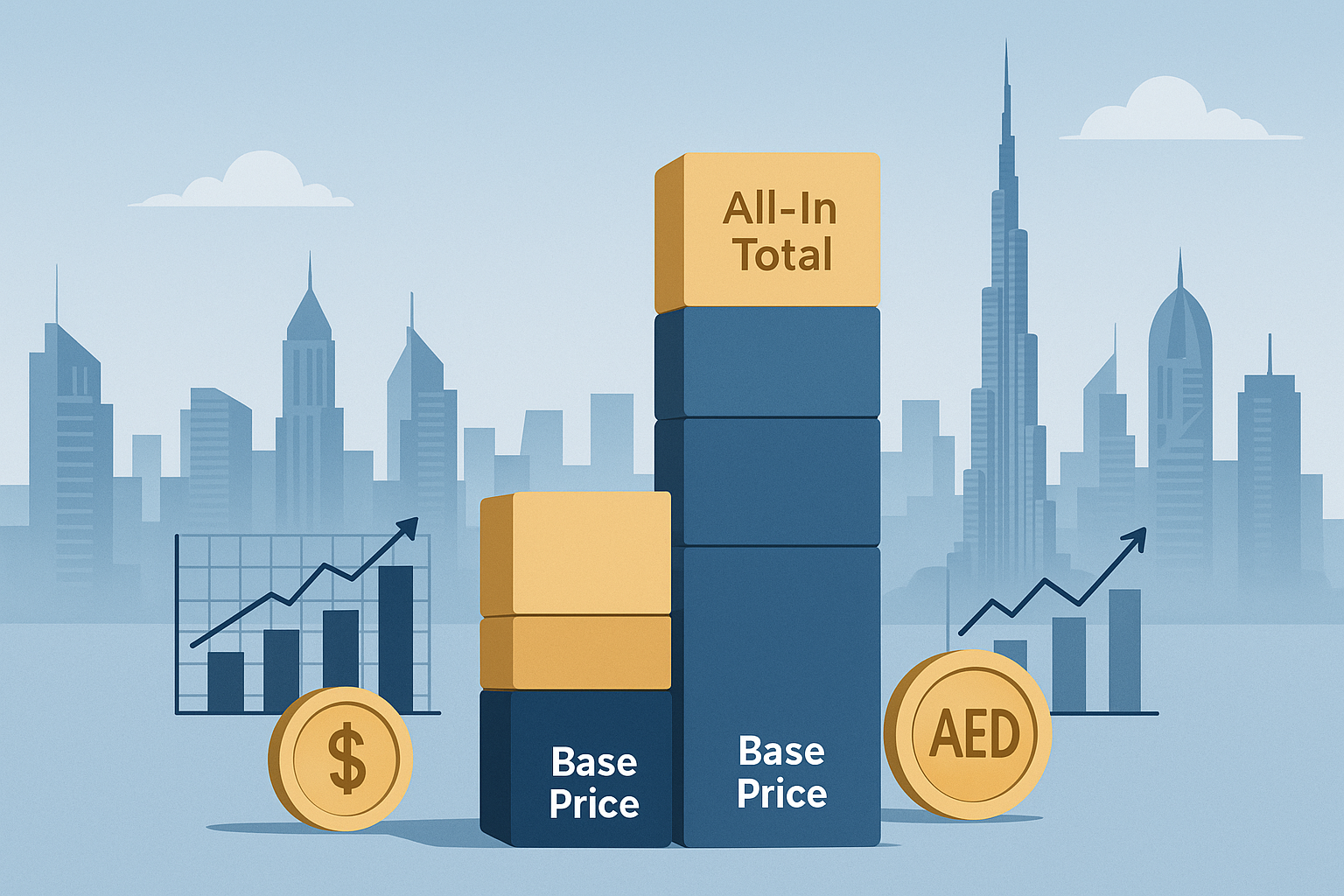
An illustration of the price build-up from base fee to all-in cost can help you see where the jumps happen — the image below gives a visual summary.
The Core Fee Components Behind Every Trade License

A trade license isn't a single line item. It's a bundle of interconnected government fees, each with its own renewal cycle. Knowing the components lets you read a quote with a critical eye.
- License issuance fee — The base fee charged by the Department of Economy and Tourism (DET, formerly the DED) for mainland, or by the free zone authority. It varies by activity, from around AED 5,000 for a simple professional license to AED 15,000+ for a general trading licence.
- Trade name reservation — A mainland licence requires you to reserve a company name with the DET (around AED 600–800, including the trade name certificate). Free zones typically bundle this into the package.
- Initial approval — A mandatory no-objection step before you can finalise the licence. This is the government confirming your activity is permitted. Mainland initial approval costs roughly AED 120–200, while free zones often absorb it into the package.
- Establishment card / immigration card — Issued by the General Directorate of Residency and Foreigners Affairs (GDRFA), this card is the document that lets your company sponsor residence visas. It’s compulsory before you can apply for any visa. Cost: around AED 1,500–2,000 per year (mainland), or AED 1,000–1,500 in free zones. You need it even if you don’t plan to sponsor a visa immediately.
- Memorandum of Association (MOA) attestation — The MOA is the legal document that sets out ownership and company structure. For mainland LLCs, drafting and notarising it costs AED 1,200–2,500, depending on the notary public and legal fees. Free zones provide their own standard incorporation documents.
- Market fees and Chamber of Commerce registration — Mainland companies pay AED 1,000–2,000 annually for Dubai Chamber membership, depending on employee count and activity. Free zones don’t have this charge.
- Government service and knowledge/innovation fees — A small fee (AED 50–100) is added to almost every transaction, from name reservation to visa stamping. Over a full setup cycle these add up to AED 300–500.
The official fee schedules are public, but navigating them alone is tedious. For current rules and tariffs, you can review the official Dubai Department of Economy and Tourism business licensing portal. For a federal overview of registration steps, the UAE Government’s business registration and licensing page is a reliable reference.
How Do Fees Differ by Activity Type?
The activity you list on your licence is the biggest driver of the trade license Dubai cost after jurisdiction. The DET and free zones classify activities into several groups, each with a different fee bracket.
- Commercial licences (trading, retail) — These let you buy and sell physical goods. A single trading activity (e.g., electronics) costs less than a “general trading” licence, which opens the door to trade in many categories at once. General trading attracts a premium: the base licence fee alone can be AED 12,000–15,000, compared with AED 8,000–10,000 for a specific trading activity. Free zones price general trading at roughly AED 12,000–14,000 base.
- Professional licences (consultancy, services) — These cover skilled services like marketing, IT, accounting, and management consulting. They are often the most cost-effective option because they don’t require a full physical office (a flexi-desk is acceptable on the mainland) and allow 100% foreign ownership. Mainland professional licence all-in costs start around AED 12,000. In free zones, professional packages with a flexi-desk and one visa start at AED 9,000–11,000.
- Industrial licences (manufacturing) — These require a warehouse or factory, environmental approvals, and larger capital, so the licence fee is higher (AED 20,000+) and the total setup cost is usually dominated by facility rent.
- Tourism and regulated activities — Travel agencies, event management, restaurants, and educational services need external approvals from authorities such as the Department of Economy and Tourism’s tourism arm (DTCM), the Roads and Transport Authority (RTA), or the Knowledge and Human Development Authority (KHDA). Each approval can add AED 2,000–5,000 to the overall cost and extend the timeline by weeks.
- Multiple activities — Every additional activity on your licence raises the fee. Typically, a second activity costs AED 500–1,000 extra on the mainland, and free zones may charge AED 500–1,500 per added activity.
The key rule: only list the activities you truly need. A single well-chosen activity keeps your licence lean and affordable year after year.
Mainland vs Freezone vs Offshore: Cost and Trade-offs
Choosing between mainland, free zone, and offshore is as much a financial decision as a strategic one. Here’s how the numbers and business freedoms compare for a typical 1–2 visa setup in 2025.
| Mainland (DET) | Free Zone | Offshore | |
|---|---|---|---|
| All-in first-year cost (1 visa) | AED 13,000–18,000 | AED 9,000–15,000 | AED 5,000–7,000 |
| Office requirement | Physical office (Ejari) for commercial licences; flexi-desk possible for professionals | Flexi-desk or hot desk included in most packages | No physical office required |
| Visa eligibility | Up to 6+ based on office size | 1–6 typically; some offer zero-visa packages | No residence visa |
| Market access | Full UAE market, government contracts | Activity confined to the free zone; can trade in the UAE via a distributor or separate branch | International business and asset holding only |
| Ownership | 100% for most activities (all professional, many commercial under FDI law) | 100% foreign ownership guaranteed | 100% foreign ownership |
| Annual renewal range | AED 8,000–15,000 | AED 5,000–12,000 | AED 4,000–6,000 |
| Best for | Retail, restaurants, professional services targeting the local market | Consultancies, tech startups, e-commerce, trading companies that don’t need a shopfront | Holding companies, SPVs, international trading firms not requiring a UAE presence |
A mainland jurisdiction — meaning you’re licensed by the DET to operate anywhere in the UAE — gives you unrestricted local market access and the ability to bid on government contracts, but the office and Chamber of Commerce fees push the first-year budget higher. Free zones bundle costs into an attractive package, and many now offer a route to the local market through dual-licence arrangements. Offshore structures are cheap and simple but remove visas from the equation entirely.
If you’re weighing a budget free zone against a professional mainland licence, check the specific visa quota rules. Some of the cheapest free zone company setup in UAE options deliver great value for solo consultants who don’t need multiple visas. For a deeper dive into free zone pricing, see our cost of setting up a company in Dubai free zone 2025 breakdown.
A side-by-side visual of mainland and free zone cost structures can make the trade-offs immediately clear. The image below illustrates the fee components unique to each jurisdiction.
Office Space and Visa Costs That Inflate Your License Budget
The price of your trade license itself is only part of the story. Office solutions and visas often double the initial outlay.
Office space requirements
- Mainland commercial licences need a physical office with a tenancy contract registered in Ejari (the official rental registration system). Even a small serviced office can cost AED 8,000–15,000 annually, and some activities demand a minimum floor area.
- Mainland professional licences can start with a flexi-desk (AED 4,000–7,000 per year), which satisfies the legal address requirement without a full lease.
- Free zones include flexi-desk or hot-desk access in their entry packages. Upgrading to a dedicated desk or office unit adds AED 3,000–10,000 per year, depending on the zone and size.
Visa costs per person Every residence visa you sponsor under your licence involves several steps, each with its own fee:
- Entry permit (AED 500–1,000)
- Status change from entry permit to residence (AED 500–700)
- Medical fitness test (AED 250–400)
- Emirates ID application (AED 300–400)
- Visa stamping on the passport (AED 500–700)
Remember, none of these can happen until your establishment card is issued — that card is the company-level prerequisite for the whole visa process.
So, planning to sponsor two visas? Budget an additional AED 4,000–6,000 on top of the licence and office costs for the first year. Free zone packages often bundle one visa into the headline price but charge AED 3,000–4,500 for each additional visa.
If you plan to bring your family, dependent visas follow a similar cost structure, plus a minimum salary requirement (typically AED 4,000 with accommodation, or AED 3,000 with company-provided housing). Our article on UAE investor visa cost explains those figures in detail.
What Are the Hidden and Surprise Charges to Watch For?
Quotes that look too tidy usually leave out the extras. Here’s where costs often catch business owners off guard.
- External approvals — Activities related to food, health, education, or transport need sign-off from bodies like Dubai Municipality, the Ministry of Health, the RTA, or KHDA. Each approval can cost AED 2,000–7,000 and take weeks. We always map out required approvals before you commit.
- PRO and typing centre fees — A PRO (public relations officer) handles document submission and government liaison on your behalf. Even with a consultant, processing and typing fees typically run AED 1,000–2,500 for the whole setup. These PRO services keep your paperwork moving without you queuing at counters.
- Document attestation and translation — Non-Arabic documents (the MOA, degree certificates for professional licences) must be legally translated and attested. Budget AED 500–1,500.
- Bank account opening minimums — Some UAE banks require a minimum balance of AED 10,000–50,000 for business accounts. It isn’t a fee, but it ties up capital immediately.
- Health insurance — Visa holders must carry compliant medical insurance. Basic packages start at AED 800–1,500 per person per year.
- Late penalties — A lapsed trade licence incurs fines of roughly AED 250–500 per month on the mainland; free zones have their own penalty structures. Letting a visa expire without renewal adds overstay fines (commonly AED 50 per day).
- Consultant markup — A setup consultant’s management fee may be buried inside an “all-in” price. We operate on transparent, line-item pricing so you see exactly what goes to the government and what covers our hands-on support.
Trade License Renewal Costs: What to Budget Annually
Renewing your trade licence in Dubai is not a mere formality—it triggers a fresh set of fees, though usually lower than the initial setup because one-time charges like notary fees, initial approval, and attestation disappear.
Typical renewal ranges:
- Mainland professional licence: AED 8,000–12,000 (including office, establishment card, Chamber fees)
- Mainland commercial licence: AED 10,000–15,000 (depending on visa count and office)
- Free zone licence with 1 visa: AED 5,000–9,000
- Free zone licence with 2–3 visas: AED 9,000–12,000
You must have a valid Ejari (for mainland) or a renewed flexi-desk agreement before the licence renewal can be processed. Visa renewals are separate and typically occur every two years, adding the medical, Emirates ID, and stamping fees mentioned earlier.
Avoid letting the licence expire. Fines start from day one, and an expired licence can freeze your immigration file, making visa renewals impossible until you clear the penalties. For a full picture of launch and renewal costs together, see our breakdown of how much it costs to start a business in Dubai.
Step-by-Step: How to Price Your Trade License Accurately
You can build a realistic budget by following a clear sequence. Use this process to evaluate quotes from any provider.
Step 1: Define your business activity. Look up the DET or free zone activity list. Confirm whether your activity is commercial, professional, industrial, or tourism-related. The activity code determines base fees and approval needs.
Step 2: Choose jurisdiction based on market access and ownership. If you plan to open a shop or sell directly to UAE consumers, mainland is non-negotiable. If you’re consulting online or trading goods that never physically enter the country, a free zone often costs half as much.
Step 3: Determine the number of visas required. Only activate the visas you’ll use in the first three months. Don’t buy a four-visa package if you’re the sole employee—unused quotas still carry establishment card and medical insurance costs.
Step 4: Select your office solution. For mainland professionals, a verified flexi-desk keeps costs low and satisfies the legal requirement. For commercial traders, negotiate a practical office that meets the floor-area rule without overpaying.
Step 5: Add government fees, approvals, and one-time setup costs. Use a checklist: name reservation, initial approval, licence issuance, establishment card, MOA (mainland LLC), Chamber registration, and any external approvals. Add PRO/typing fees and attestation.
Step 6: Get itemised quotes and compare against the all-in total. Ask for a line-by-line quote that separates government charges from service fees. This is the only way to rule out hidden markups.
Sample budget: 2-visa free zone consultancy (approximate)
| Item | Cost (AED) |
|---|---|
| Trade licence (professional) | 7,500 |
| Name reservation & initial approval | Included |
| Establishment card | 1,200 |
| Flexi-desk (annual) | 4,000 |
| 2 x visa package (entry permit, status change, medical, Emirates ID, stamping) | 7,000 |
| Medical insurance (2 persons, basic) | 1,800 |
| PRO & processing | 1,500 |
| Total first-year cost | AED 23,000 |
This figure is far from the advertised “AED 7,500 licence” you’ll see online, but it reflects every dirham you actually need to spend.
Common Mistakes That Lead to Overpaying
Even experienced entrepreneurs get the trade license Dubai cost wrong by falling into these traps.
- Choosing general trading when a single-activity licence is enough. General trading costs AED 3,000–5,000 more in annual fees. If you’re only importing electronics, a specific trading licence is cheaper and perfectly valid.
- Over-buying visa quotas. One extra unused visa adds AED 3,000–4,000 to the first year, plus ongoing renewal costs. Start lean and add visas only when you hire.
- Picking mainland when a free zone fits the business model. If you don’t need a shopfront or government work, a cheapest freezone licence in UAE can save you AED 10,000+ annually.
- Ignoring renewal and recurring costs in year-one budgeting. Many companies stumble because they budget AED 15,000 for setup but can’t cover the AED 12,000 renewal plus visa costs the following year. Plan for both.
- Falling for “50% off” promos that exclude visa and office fees. The promo may cut the licence issuance fee, but the establishment card, visa, and office charges remain untouched. Always ask for the final all-in invoice.
- Not factoring corporate tax registration and VAT compliance costs. Companies with taxable supplies over AED 375,000 must register for VAT, and most businesses now fall under the UAE corporate tax regime. You can verify thresholds and obligations directly with the Federal Tax Authority. These aren’t licence fees, but accounting and compliance add administrative costs from day one.
How to Choose the Most Cost-Effective Option for Your Business
The right structure depends more on your business model than on the lowest sticker price. Here’s a decision matrix we use with clients at Al Ain Business Center.
Who are you?
- Solo freelancer / service professional → Free zone professional licence with 1 visa and flexi-desk. All-in: AED 9,000–12,000 first year. This is often the cheapest fully functional setup.
- SME with a physical product to sell in the UAE → Mainland commercial licence with a small office or retail unit. Budget AED 16,000–22,000 for year one, but you gain unrestricted local trading rights.
- International trading firm that never touches UAE soil → Offshore company. Setup cost AED 5,000–7,000, with no visa. Pair it with a free zone office later if you need a residence visa.
- Investor seeking long-term residency → A mainland or free zone company can qualify you for an investor visa, and with sufficient capital, the Golden Visa Dubai cost pathway opens up a 10-year residency without a local sponsor. For Indian nationals, we’ve detailed the requirements in our Dubai Golden Visa guide for Indian citizens, and the application process is explained here.
The lowest-cost path for service professionals remains a free zone consultancy licence with a flexi-desk. For anyone who needs mainland market access, the professional licence route through the DET offers similar cost efficiency without the trade-off.
When an offshore structure fits, it’s unbeatable for cost—but only if you genuinely don’t need UAE visas or local clients. For a wider view of startup budgets across jurisdictions, our cost to start a business in Dubai guide compares scenarios side by side.
Your Next Step: Get an Itemised Quote, Not a Surprise
Understanding the trade license Dubai cost line by line is the only way to protect your budget. At Al Ain Business Center, we never hide fees in bundled packages. We give you a fully itemised quotation that breaks down government charges, office costs, visa fees, and our service management fee—so you know exactly what goes where.
Every day we help entrepreneurs set up in the right jurisdiction, avoid unnecessary activity additions, and launch with a budget that makes sense from year one. If you’d like a personalised calculation for your business activity and visa needs, book a free consultation with our team. We’ll walk you through the numbers in plain English and send you a written proposal before you commit a single dirham.
References and further reading:
- Dubai Department of Economy and Tourism – Business Licensing
- UAE Government – Business Registration and Licensing
- UAE Federal Tax Authority – VAT and Corporate Tax
Frequently Asked Questions
What is the cheapest trade license in Dubai?
The cheapest option is a free zone trade license with zero visas and a flexi-desk, starting around AED 5,750–8,500 all-in. Offshore structures are even cheaper at AED 5,000–7,000, but they don't allow residence visas. Professional licenses are also cost-effective since they don't require a full physical office.
How much does it cost to renew a trade license in Dubai?
Renewal fees are similar to first-year costs minus one-time approvals. Expect roughly AED 8,000–15,000 annually for mainland, AED 5,000–12,000 for free zones, and AED 4,000–6,000 for offshore. Always budget for renewals annually, not just at launch.
Can I get a Dubai trade license without an office?
Yes. Mainland professional licenses can start with a flexi-desk (AED 4,000–7,000 per year) that satisfies the legal address requirement, and most free zone packages include flexi-desk or hot-desk access. Offshore structures require no physical office at all. However, mainland commercial licenses do require a physical office registered in Ejari.
Is a freezone or mainland license cheaper?
Free zone licenses are generally cheaper, with all-in first-year costs of AED 9,000–15,000 for a 1-visa setup, compared to AED 13,000–18,000 for mainland. Mainland costs are higher because of office leases and Chamber of Commerce fees, but it gives full UAE market access and government contract eligibility.
How long does it take to get a trade license in Dubai?
Standard setups with no external approvals can be completed relatively quickly. However, regulated activities such as tourism, restaurants, or education require approvals from bodies like DTCM, RTA, or KHDA, which can add several weeks to the timeline.
Do I need to pay for a visa separately from the trade license?
Yes, visa costs are usually separate from the base license fee. Each residence visa involves an entry permit, status change, medical test, Emirates ID, and stamping, totaling around AED 2,000–3,000 per person. Budget roughly AED 4,000–6,000 extra for two visas in year one, though free zones often bundle one visa into the headline price.